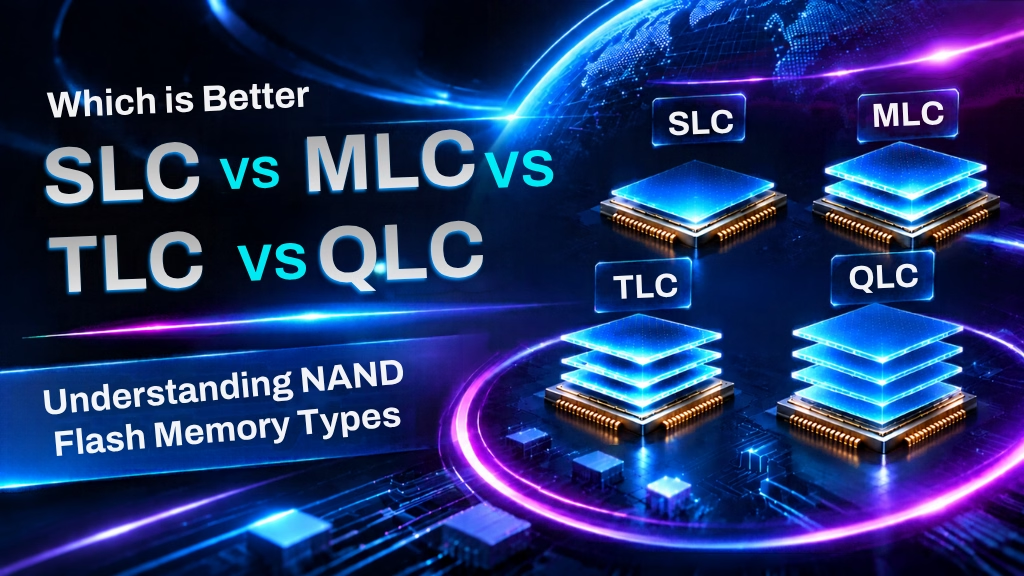
NAND Flash memory is used in almost any device that needs to store information, but there are a range of different memory types and they all offer different performance and endurance capabilities. Single-Level-Cell (SLC) was the original design and though it’s extremely durable, it’s expensive and only available in low capacities. MLC, TLC, and QLC are all cheaper, but come with their own drawbacks and difficulties.
You’ll find some form of NAND Flash memory in just about every modern electronics device. But just as device designers need to pick the right capacity and performance of the memory and storage the device is built around, the type of NAND Flash memory it uses is important too. It can have a large impact on battery life, device durability, and how snappy and responsive it feels.
There are four main types of NAND Flash memory, each with their own performance and endurance capabilities, and varying price tags: SLC, MLC, TLC, and QLC. In a nutshell, SLC is the fastest and most durable, while QLC is the cheapest and most affordable for large-capacity drives, but there’s a lot of nuance and reasons to pick SSDs and memory cards built around one memory type or another.
Memory types explained
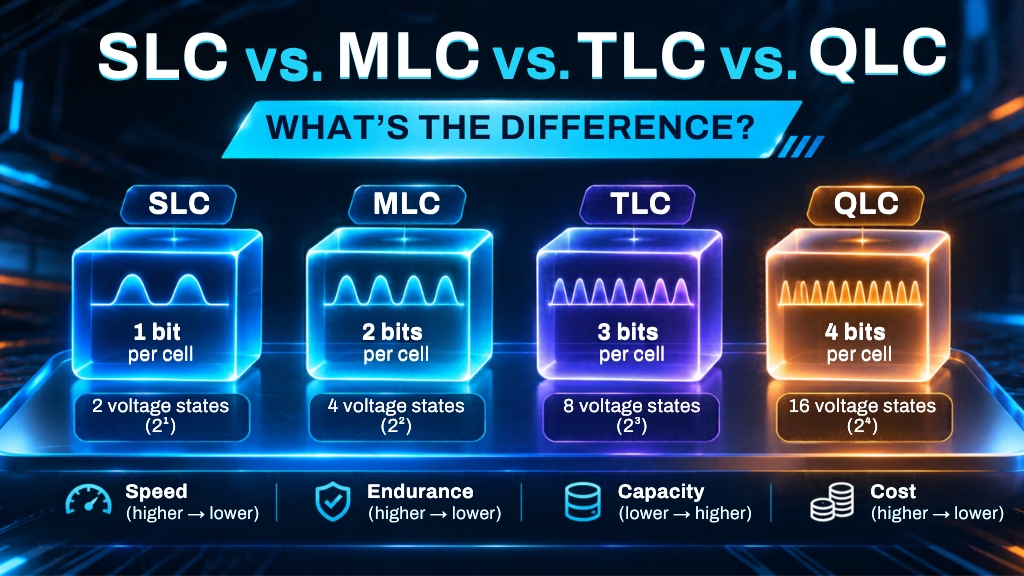
The original memory type was Single-Level Cell (SLC). Able to store just one bit per cell it only has to retain one of two different voltage states. This allows it to be extremely durable, able to withstand around 100,000 program-erase cycles before the flash cells start to wear down. However, this durability and simplicity comes at the cost of physical space, because the NAND chips need to be stacked next to one another and in greater quantities to achieve the same capacity as multi-level cell memory.
MLC, or Multi-Level Cell memory can store two bits per cell, doubling the capacity per cell of SLC. However, to do that it needs to be able to switch between four different voltage states. That eats into its durability, with MLC cells able to withstand around 10,000 program-erase cycles before degrading. So around 1/10th that of SLC. It’s not as fast as SLC either, but its cheaper to produce and easier to build larger capacity drives.
Triple-Level Cell, or TLC, is the most common memory cell type used in premium SSDs in 2026. It offers a sweet spot in performance, durability, capacity, and pricing, though is still more expensive than QLC. It can store three bits of data per cell by switching between eight different voltage states. This enables an enormous leap in data density over MLC, which is why it’s so useful for building larger SSDs and memory cards that still offer strong performance. Performance is further enhanced using DRAM and SLC cache to boost write speed over shorter workloads.
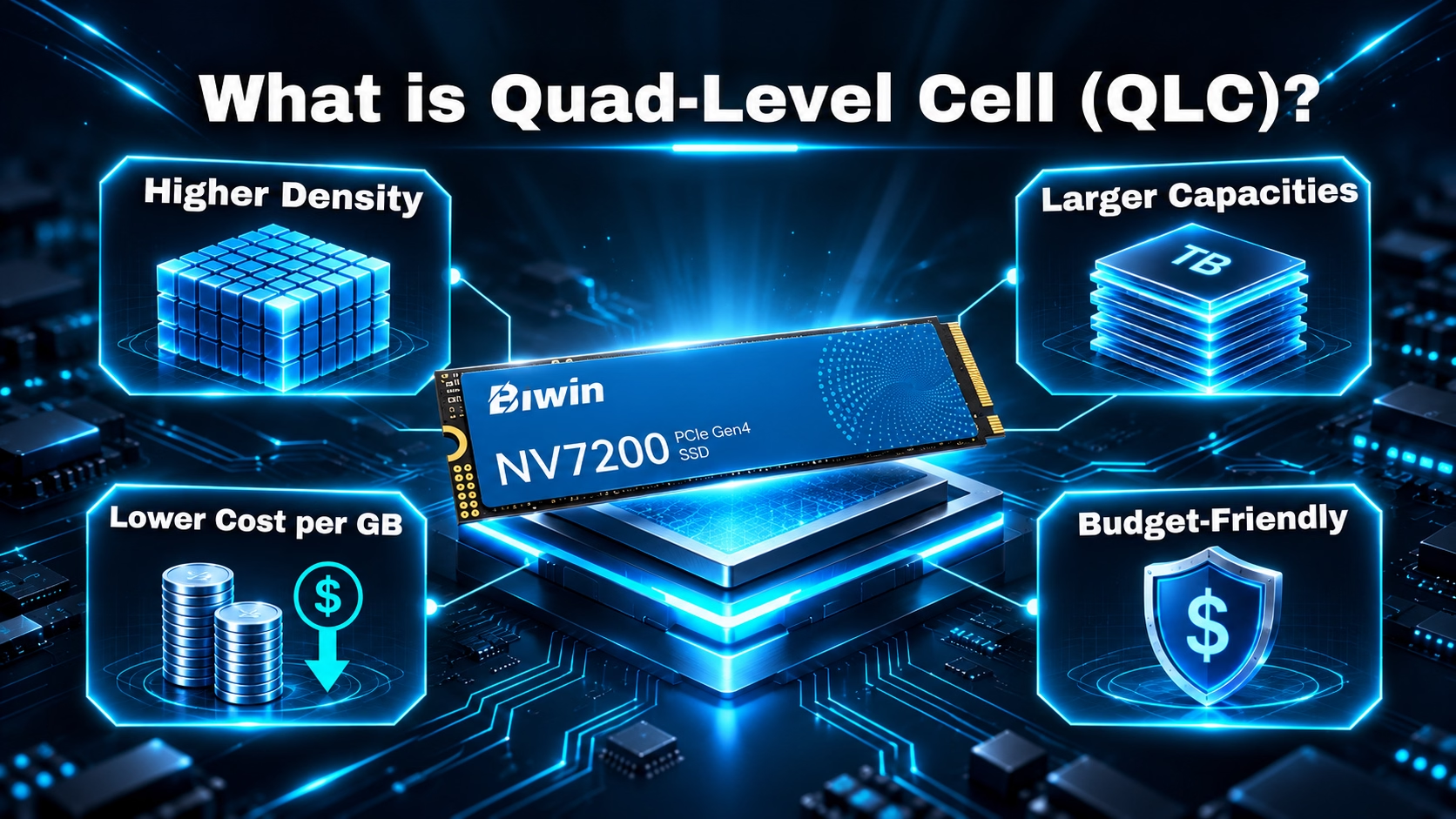
QLC, or quad-level cell memory is the most dense and least durable memory cell type. It can store four bits of data by leveraging 16 distinct voltage states. You’ll find most 4TB and 8TB SSDs use QLC NAND flash as otherwise the drives would simply be too expensive.
However, QLC is the least durable memory cell type, with some QLC SSDs offering TBW ratings only in the low hundreds, giving these drives a shorter lifespan than their TLC counterparts. It is the most affordable, though, so the cheapest entry-level SSDs are often built around QLC, too.
SLC vs. MLC vs. TLC vs. QLC: Which is Better?
Each memory cell type has its strengths and weaknesses, but from a consumer perspective, TLC and QLC NAND Flash memory are the best types for everyday use. For premium storage solutions where performance and durability are worth paying a little extra for, TLC is the superior choice.
However, for more affordable storage devices, QLC NAND Flash is an excellent alternative; Especially for larger capacities. If you’re buying a big multi-terabyte SSD to replace an aging hard drive, a QLC SSD is an excellent choice. Look out for one with a DRAM or SLC cache too, to enjoy much greater performance for shorter workloads.
Still unsure which NAND flash type is right for your needs? Read our guide, Which is Better, SLC, MLC, TLC, or QLC? How to Choose, to compare their strengths and find the right option for your storage needs.
TLC or QLC for Your SSD?
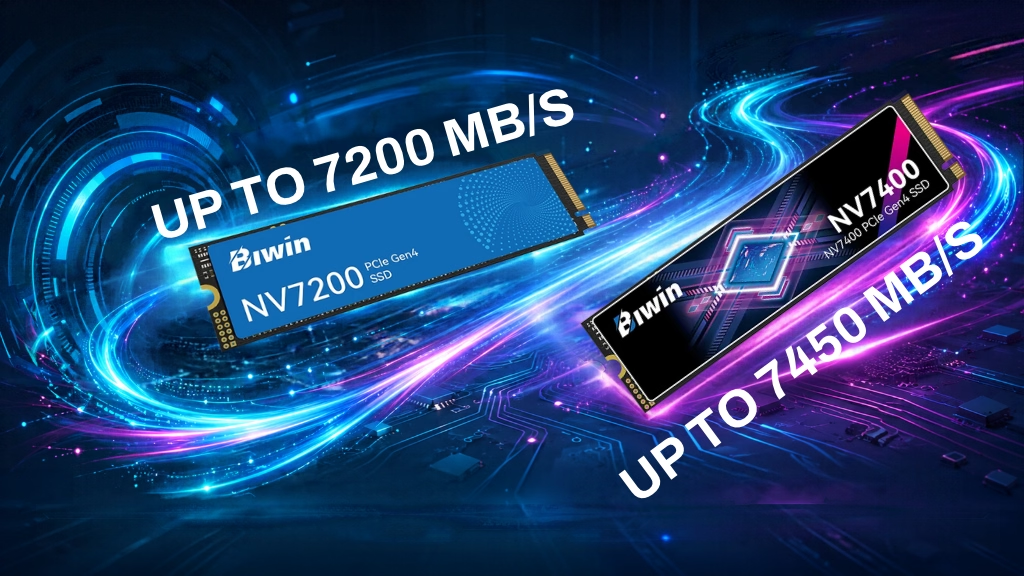
For most consumers buying an SSD today, TLC and QLC are the two memory types they’re most likely to choose between. TLC is the more expensive of the two, but its better performance and endurance makes it worth considering for a drive that’s going to see heavier use. That includes SSDs like the Black Opal NV7400, which uses TLC NAND Flash. It’s a good fit if you want the benefits of TLC and don’t mind spending more to get them.
QLC makes more sense when you’d rather put that money towards extra storage. The Biwin NV7200 uses QLC NAND Flash, with its greater density helping make larger capacities more affordable. You don’t get the same endurance as TLC, but that may not matter much for a games drive, application storage, or the kind of everyday use that doesn’t involve writing huge amounts of data to the drive on a regular basis. There’s a place for both, and what you use the SSD for will usually tell you which one makes more sense.