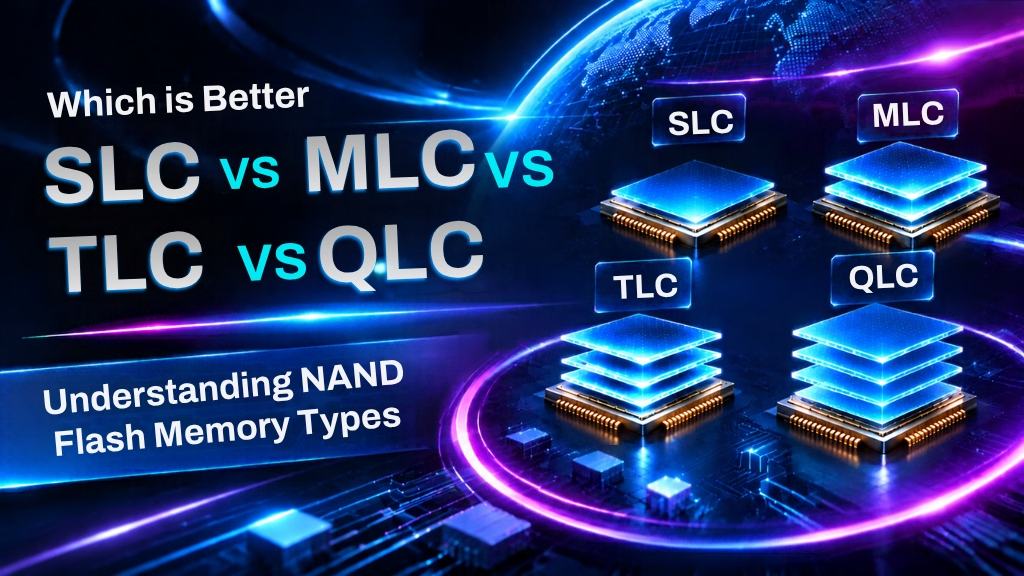
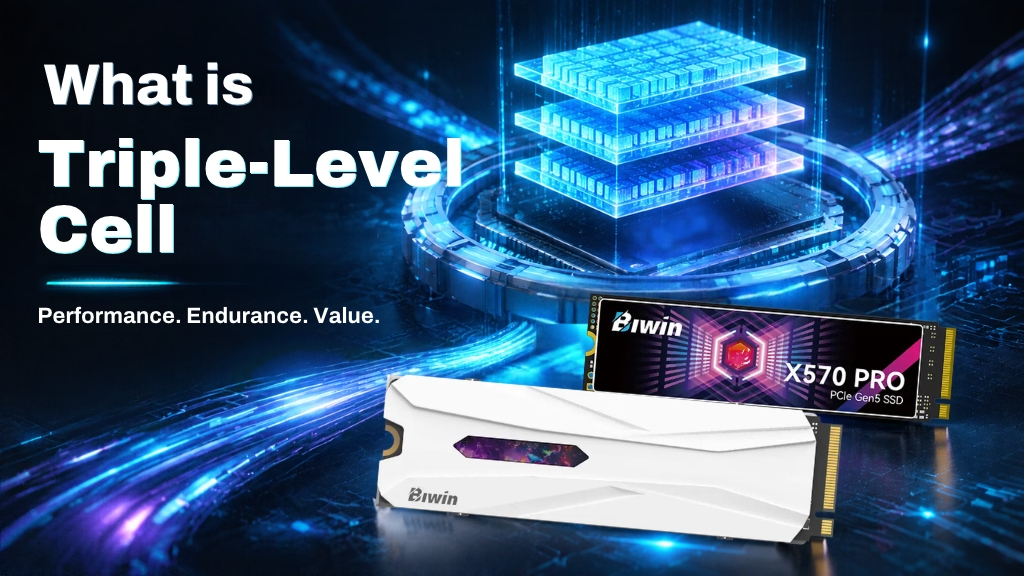
Triple-Level Cell, or TLC is, a type of memory cell used in storage devices like SSDs, built to hold three pieces of data at once. It’s similar to a multi-level cell, or quad-level cell, but where those hold two and four-bits of information, respectively, triple-level cells hold three. TLC NAND Flash offers greater performance and endurance than QLC, and greater storage density than MLC, so tends to be used in more premium storage drives.
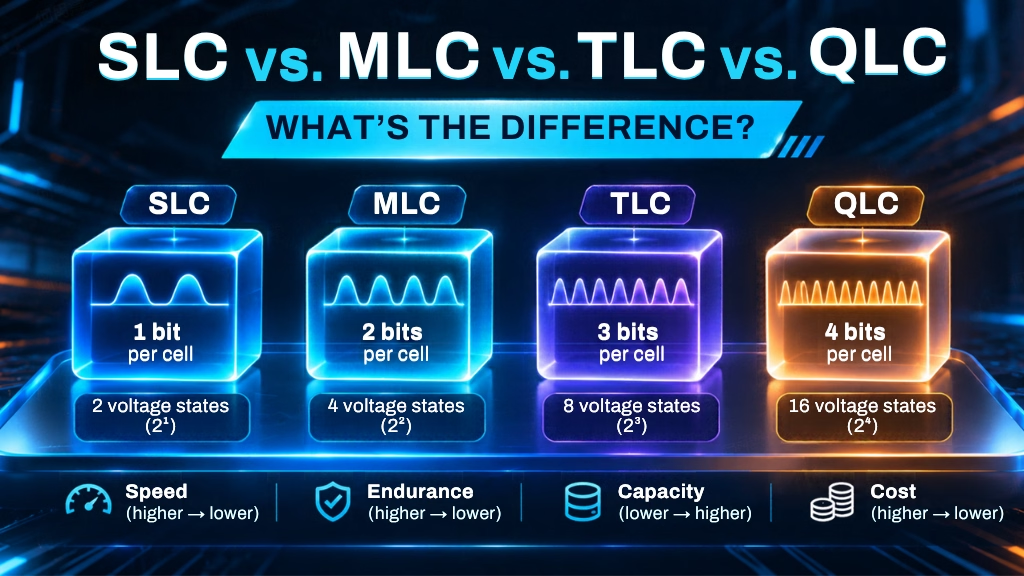
TLC, or triple-level cell, is a type of NAND Flash memory cell used in storage devices like SSDs. Like Single-Level Cell (SLC), Multi-Level Cell (MLC), and Quad-Level Cell (QLC), triple-level cells are designed to hold data, but a different quantity of data. Where SLC and MLC memory cells can hold just one, and two bits of data per memory cell, TLC can hold three. That’s denser and more affordable to produce in greater capacities.
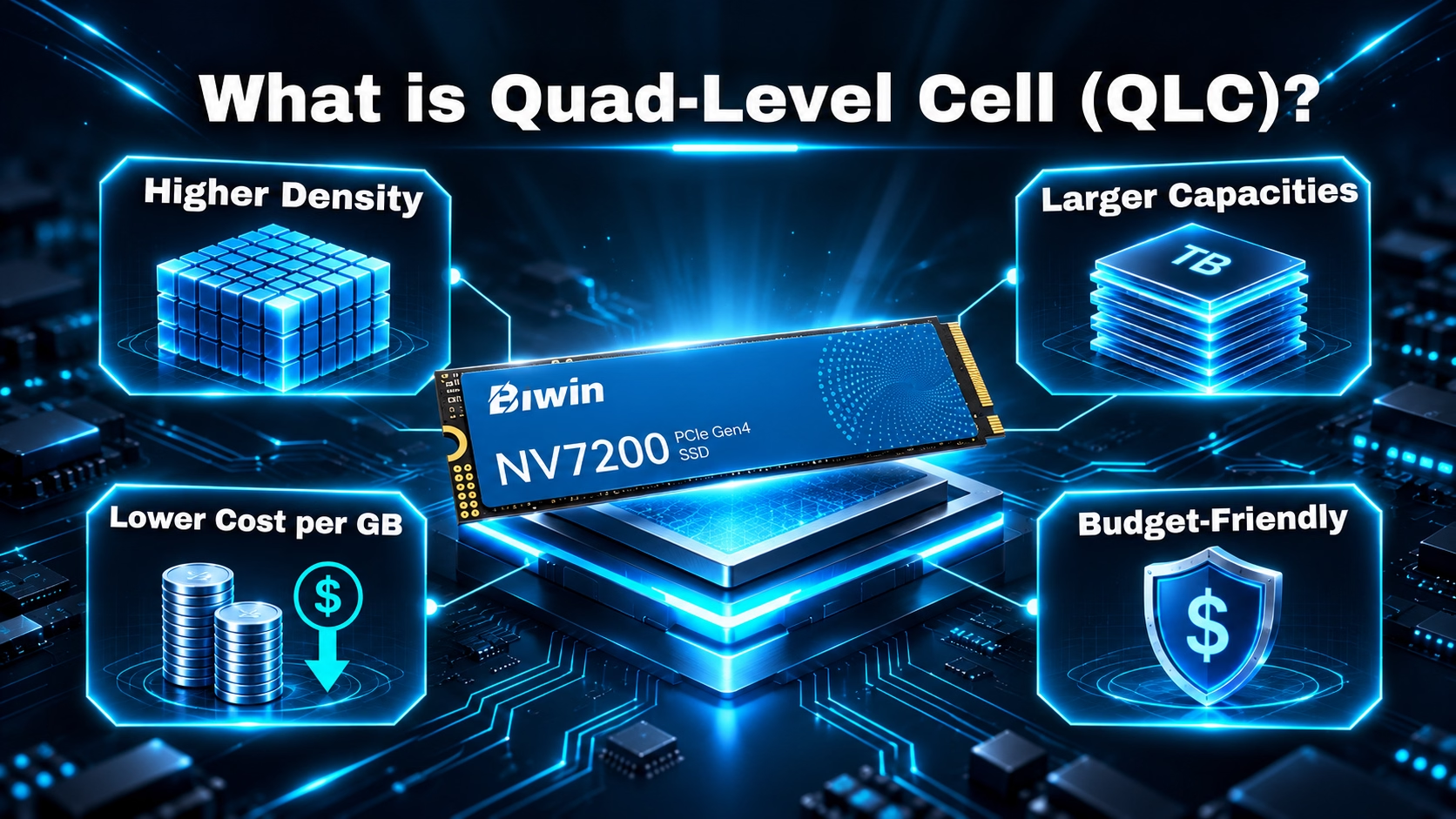
QLC can hold four bits of data, making it denser again than TLC and more affordable to produce at capacity. However, TLC can deliver better performance and longevity, making it better suited to more premium SSDs – though that comes at a financial cost.
TLC was first introduced in the late-2000s, with mass production of TLC SSDs starting in 2010. It represented a much-denser storage medium than MLC SSDs, and could be produced at a lower cost. To enhance performance, TLC SSDs also employ a fast-access cache. In the most high-end drives, this is a DRAM cache of faster DDR memory. In more affordable TLC SSDs, Biwin uses an SLC cache instead, where a portion of the drive’s capacity acts like SLC memory, storing just a single bit. That makes it possible to run at higher speeds during more limited sustained write scenarios.
Today, in the mid-2020s, BIWIN uses TLC memory with cache in our most premium high-speed NVMe SSDs, like the Black Opal X570 Pro and Black Opal X570H Pro. Although such SSDs come at a premium price in the memory-supply-constrained world of 2026, the performance is absolutely worth it if you want rapid, responsive storage.
What makes TLC different?
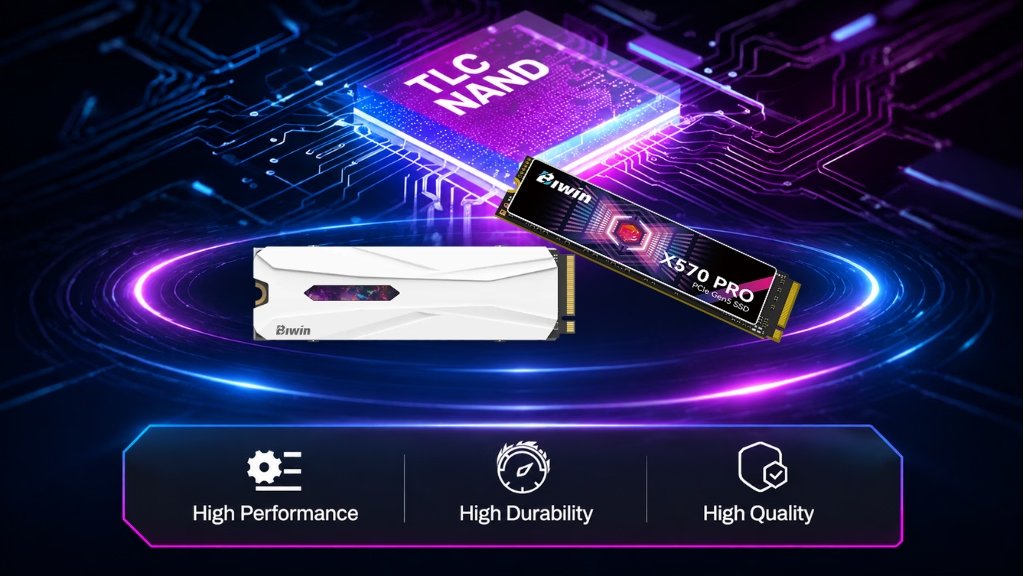
TLC memory works just like other types of NAND Flash memory cell, but compared to MLC and SLC it can operate in more voltage states to hold greater quantities of data. A TLC memory cell needs to hold one of eight different voltage states at any one time. That makes it possible to hold up to three bits of data at once, but it does impact performance and longevity. Not to the same extent as QLC, but still more pronounced than older MLC memory technologies.
Despite some drawbacks compared to MLC memory, TLC offers the best mix of performance, longevity, and price to make it the prime solution for high-performance and premium SSDs. Although QLC memory offers a more affordable storage solution for those on tighter budgets, if you’re looking for the fastest storage drives, TLC SSDs with a DRAM or SLC cache are some of the best options.
To better understand the differences between NAND Flash memory types, read our guide: SLC vs. MLC vs. TLC vs. QLC: What’s the Difference?
TLC vs. QLC
When buying a new SSD, you’ll often be faced with the question of whether it’s worth spending more on a TLC SSD, or spending less on a QLC drive. The raw performance, write endurance, and specific features of the SSDs can vary dramatically from drive to drive and manufacturer to manufacturer, but for the most part you’ll find that TLC SSDs offer better read and write performance than QLC SSDs, as well as improved write endurance.
Sustained performance is much more readily achieved with a TLC SSD with DRAM cache, though those with an SLC cache can be just as fast in shorter-run workloads.
TLC SSDs also offer greater endurance than their QLC counterparts. Where a TLC SSD can have a rating in excess of 1,000 TBW in some cases, QLC SSDs are typically limited to TBW rating of between 100 and 400.
In reality, most consumers aren’t likely to use up an SSD’s TBW rating throughout the lifespan of the drive. Even with less durable QLC drives, you’re still able to completely erase the drive and fill it hundreds of times before you’ll run into issues. With average everyday use, that’s unlikely to happen for years or even decades.
That said, it doesn’t take away from the fact that TLC memory is more durable. If you expect to perform heavy write loads regularly, or just want increased peace of mind with your storage solution, TLC SSDs are the more trustworthy option.
Is a TLC SSD worth it?
If you want cutting-edge SSD performance and added longevity: Yes. Although TLC SSDs and memory cards do come at a premium price, especially with the supply-constrained global memory prices of 2026, TLC SSDs still offer the best mix of performance and endurance compared to their QLC counterparts. Especially if you expect to run through the smaller SLC caches on QLC drives, after which performance can severely drop off.
If you can find space for it in your budget, a TLC SSD is a better option. as a boot drive or game library holder. On the other hand, QLC SSDs are a fine alternative, particularly for larger, longer-term storage.