Gaming has always been shaped by the hardware that powers it. But while CPUs and GPUs still drive the rendered experience, graphical fidelity is no longer shaping what a next-generation experience feels like. As game assets and digital worlds grow ever larger, it’s storage that is set to be the next revolution in gaming hardware.
Hardware has always shaped games. Early arcade cabinets needed custom hardware, bulky enclosures, and sturdy frames to support heavy CRT displays. Games consoles with their proprietary hardware offered unique gaming experiences based on their controller types and internal processors. Gaming PCs first leaned on faster CPUs, then dedicated graphics cards to render richer and more detailed virtual worlds.
But the pace of perceived fidelity progression in game development has slowed. While leaps from earlier console and graphics card generations introduced noticeable improvements in how real games feel, the visual realism of the latest games doesn’t feel that distinct from games of five years ago. Developers will continue to make games more realistic and immersive, but graphics improvements are no longer giving the same generational leaps they did 20 years ago.
And yet the demands of modern games continue to rise. Alongside the need for more capable graphics cards with more video memory and faster processors, storage demands have sky-rocketed. More expansive virtual worlds, and more detailed in-game assets require much larger storage capacities to handle. Where games of the 2000s might have topped out at a few tens of gigabytes for the real outlier games, it’s not uncommon for the latest big game release in 2026 to demand well over 100 GB. There are a few games out there that even blow right through 200 GB and more – especially when you factor in after-release modification and live service content.
This makes storage a key factor in enabling modern gaming experiences, and especially so in more compact devices. In 2026, although PC gaming is still driven by key devices like desktop PCs and laptops, it’s becoming increasingly popular in portable handheld gaming systems, and mixed reality headsets continue to enable high-fidelity, PC-gaming experiences through Steam and Meta platforms.
Local AI use for generative game content will also impact game footprints in the future, though AI-powered compression algorithms and faster asset streaming could simplify the pipeline from drive to memory.
From desktop PCs to compact portable gaming systems, storage is a core component of the next-generation of gaming hardware and the experiences it powers.
Graphics still matter, but fidelity isn’t all that defines the next-generation
Graphical realism and eye-catching art styles have been a hallmark of generational gaming development since their inception. From dots on a screen, to full color, to sprites, polygons, voxels, and ray traced lighting, there have been many generational-defining leaps in graphical capabilities. Often that comes from the developers pushing the boundaries of what’s possible, and other time’s it’s because the hardware to power them unlocked some new capabilities in lighting or physics.
But great graphics have never never been a replacement for strong mechanics[1: Eindhoven University of Technology], and the diminishing returns of graphical realism mean modern games don’t make the kind of leaps they did in generations past. Where the jump from 2D to 3D was transformative, and the transition from the PS2 to the PS3 dramatic and obvious, games released in the mid-2020s don’t look much more realistic or immersive than the games released at the end of the 2010s. Cyberpunk 2077 is over five years old, and it’s still held up as an example of one of the best looking games available today.
But where new game releases can still wow with graphics, it’s more often an eye-catching art style or artistic choice made by the developers that helps them stand out. Many games of recent years offer incredible fidelity, and continued updates in ray tracing and dynamic upscaling have helped them stay relevant and on the bleeding-edge of what’s possible.
Beyond graphics, though, these continual updates and live service content, AI generative features, and a broader PC gaming hardware ecosystem means storage is playing an ever-more important role in defining modern gaming.
Modern gaming is increasingly gatekept by storage demands
Gamers wanting to run their games at high settings are still bottlenecked by their graphics card VRAM, display resolution, and processor speed, but for many gamers the first hurdle is simply finding enough space to install the game. Many modern games demand over 100 GB of storage capacity to install, some over 200 GB – especially when you factor in post-launch updates and live service content [2: Techspot]. That makes modest 500 GB SSDs only capable of handling 2-3 large AAA games alongside operating system files and background applications.
The price of storage for the consumer has risen dramatically in the last year, too. Due to shortages induced by AI industry infrastructure buildout, the combined price of memory and SSDs will have risen by 130% by the end of 2026 [3: Gartner], making it costly to upgrade storage capacity for new, larger games.
That problem is only exacerbated in more compact gaming devices, like handheld gaming systems. Although some leverage new technologies like the Biwin Mini SSD to provide high-capacity, high-speed storage, many devices are limited to smaller capacity SSDs and SD cards due to constrains on physical space and device bill of materials.
All this makes capacity planning a key consideration for gamers. When buying a new device or upgrading an existing one, storage is often a limiting factor in what games can be played, and how many of them can be installed at once and ready for play. Devices and storage components that feel premium when new, can quickly become inadequate as new games demand more storage space to install and maintain.
Storage is no longer just something you need to retain a small subset of your budget for, it’s an expensive part of the overall device price tag that needs to be considered in order to retain functionality, and extend its usable lifespan.
Biwin offers a range of NVMe SSDs at capacities between 512GB and 8TB, giving gamers, enthusiasts, and professionals options tailored directly to their needs. For older systems, or more affordable storage upgrades, Biwin’s range of SATA SSDs are available in capacities up to 2TB. Portable storage adds versatility, with Biwin external SSDs available in capacities up to 8TB, while more compact MiniSSD and microSD card storage is available in multi-terabyte capacities.
Storage performance matters almost as much as capacity
As important as capacity is in storage, though, that’s only half the equation. As modern games are designed more with SSDs in mind, the performance of these drives is becoming a mandatory threshold as much as the install capacity. Many modern games, including Starfield and Indiana Jones and the Great Circle list an SSD in their storage requirements alongside an install size, while Doom: Dark Ages mandates an NVMe SSD [4: Bethesda, Bethesda, Bethesda]. Even when it’s not mandatory, the developers often heavily recommend it. In CyberPunk 2077, [5: CD Projekt Red] the developer recommends an SSD to maintain a consistent quality experience throughout the game, and suggests an NVMe SSD is necessary at higher detail settings. Hard drives, and even older SATA SSDs can’t always keep up.
Console manufacturers have also made high-speed SSDs a mandatory requirement for gamers and game developers. Both the Xbox Series X/S and PlayStation 5 consoles use NVMe SSD storage in their base consoles. For gamers who want to expand that to increase their available install size, they need to use modern, fast SSDs. Sony suggests a PCIe 4 SSD with at least 5,500 MB/s sequential read speed [6: Sony] for sustained performance, while Microsoft uses a proprietary Storage Expansion card with a custom NVMe SSD, rather than a standard M.2 SSD.
These storage demands are designed to enable faster game load times and more expansive open worlds that feel seamless and don’t require many of the traditional level loading tricks and techniques that game developers have relied on in the past. Moving beyond elevator rides or game-interrupting loading screens needs both fast hardware and smart game design.
Microsoft introduced its DirectStorage technology in 2022 and has continued to evolve it in the years since with the introduction of Zstd compression to streamline game assets to reduce game load times [8: Microsoft]. Although this technology still has limited adoption among fully released games, the effect it can have on load times can be significant. Researchers found it effective at accelerating the streaming of time-dependent particle data sets from storage to the GPU [9: Springer], and games that have used it tend to offer a real loading speed advantage when running the game from a faster SSD.
Biwin’s SSD portfolio spans mainstream storage upgrades for desktops and laptops and compact storage solutions for portable gaming systems, giving gamers a wide range of options for speed, capacity, and form-factor. PCIe 4 SSDs like our NV7400 offer excellent performance for PC and console gaming. For those who want cutting-edge SSD performance for the fastest game load times and robust future proofing against future gaming demands, the Black Opal X570 Pro is our flagship SSD with high-tier performance ratings at a range of capacities.
Compact gaming challenges
Modern PC gaming is no longer constrained to the stalwarts of the industry: Gaming desktops and laptops. In 2026, PC gaming extends into portable handheld gaming devices like the Steam Deck and Asus ROG Xbox Ally X, gaming tablets, mixed reality headsets, and powerful smartphones designed specifically for gaming. As these devices are more constrained in terms of physical space and require battery power to operate, they place unique demands on the device’s storage design.
The more compact nature of these devices means traditional SSDs are rarely the right fit, demanding the use of more bespoke form factors of storage. These solutions also need to offer the strong performance modern gaming demands, all while operating within safe temperature bounds.
The smaller and more portable a device is, the more consequential its storage design becomes. Faster storage might deliver greater performance, but it needs to consider battery life and thermal constraints. If it isn’t directly upgradeable or replaceable, there needs to be a secondary storage option that’s hot swappable or expandable.
Desktop gamers can always add another SSD, but compact portable gaming reduces options, making up front storage selection more impactful, and device design around storage all the more important.
Biwin offers NVMe SSDs in more compact form-factors, including 2230, which can be a strong fit for portable gaming devices like the Valve Steam Deck. We also offer gaming-focused microSD Express cards that leverage PCIe NVMe performance while offering broad compatibility with a range of gaming devices.
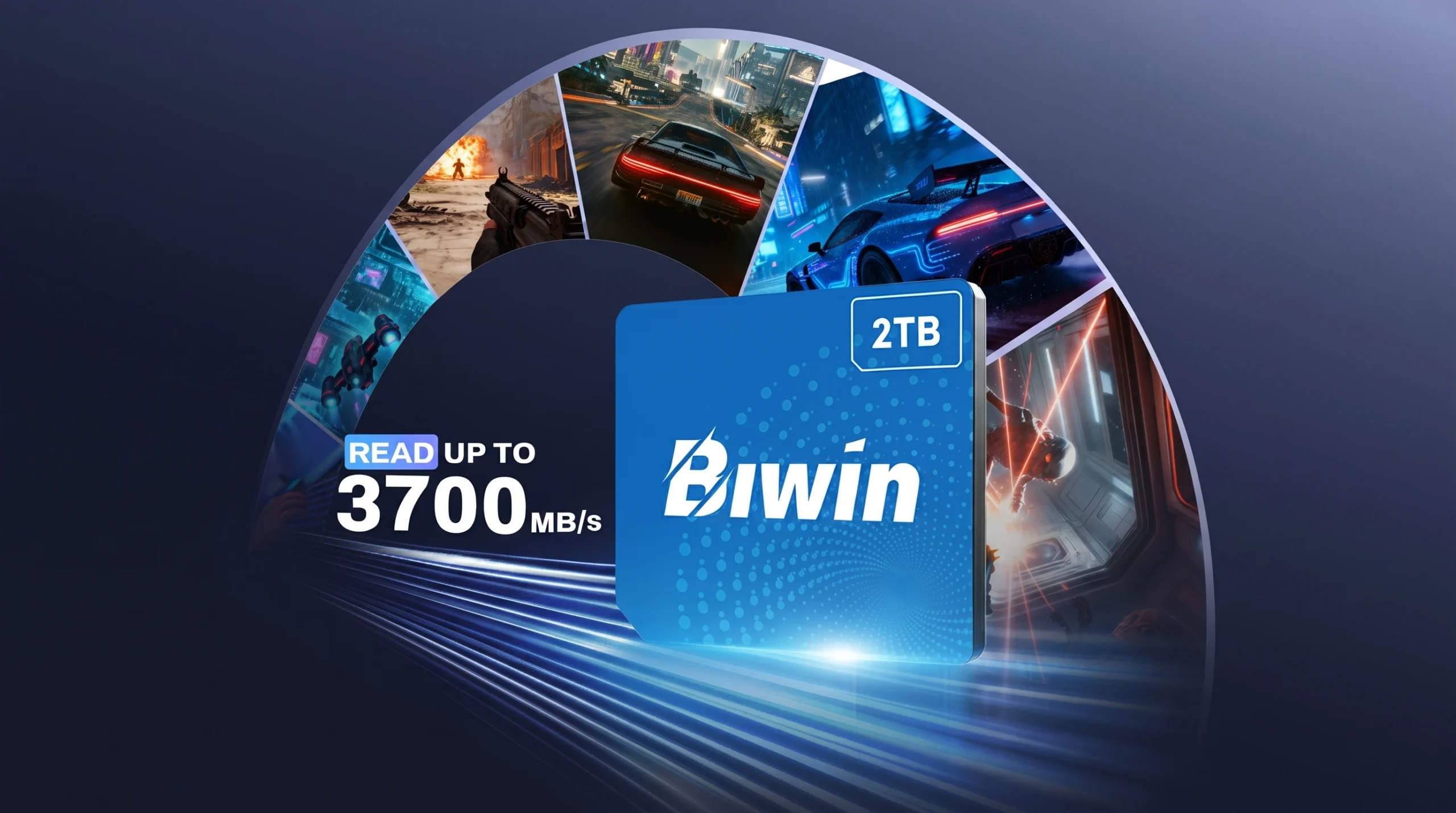
Biwin is also innovating in this space, having developed the world’s first MiniSSD. This Edison Award winning creation [10: Edison] uses the PCIe 4 interface to deliver performance akin go mid-range SSDs, with sustained read and write speeds up to 3,700 MB/s and 3,400 MB/s, respectively, at up to 2TB capacity. This micro storage solutions measures less than 20 mm a side and was built into the GPD Win 5 to deliver high-speed, expandable storage for portable gaming in a tiny footprint.
Mini SSD: A New Storage Form Factor for Compact Gaming
The continued expansion of portable gaming devices is creating new requirements for storage solutions. Smaller systems have less physical space available for components, while still needing the performance required to support increasingly large and complex game installations. This makes compact, high-performance storage an important part of future gaming hardware design.
Following the development of its Mini SSD platform, Biwin’s Mini SSD CL100 brings PCIe-based NVMe storage performance to an ultra-compact form factor. Measuring just 15.00 × 17.00 × 1.40 mm, the CL100 uses a PCIe 4.0×2 interface and NVMe 1.4 protocol to deliver sequential read speeds of up to 3,700 MB/s and sequential write speeds of up to 3,400 MB/s.
For portable gaming systems, this level of storage performance helps reduce loading times, improve asset streaming, and provide faster access to large volumes of game data. As modern titles continue to expand through larger environments, higher-resolution assets, and ongoing updates, storage solutions that combine performance with compact design will become increasingly important.
By delivering high-speed NVMe storage in a significantly smaller footprint, the Biwin Mini SSD CL100 demonstrates how new storage form factors can help overcome the physical constraints of portable gaming devices and support the next generation of gaming experiences.
However, storage challenges in gaming will continue to evolve beyond physical device constraints. As new technologies introduce more complex workloads and larger volumes of local data, future gaming systems will need to adapt to changing storage requirements in new ways. To learn more about this compact storage form factor, see our guide to What is Mini SSD: Everything You Need to Know.
AI could add to storage requirements in unpredictable ways
The most prevalent AI in gaming to date has been in dynamic upscaling and frame generation – improving performance with more efficient AI algorithms rather than brute forcing greater rasterization or ray tracing capabilities. But this is only the beginning of AI’s integration in gaming, and there is real potential that generative AI could help expand gaming worlds and make them feel more dynamic and alive; But that could come at the cost of greater storage requirements.
Researchers at the University of Copenhagen [11: ResearchGate] experimented with using small language models running locally on a gaming system to introduce AI-generated allies and opponents, as well as generating NPC and quest dialogue dynamically in-game. Nvidia has also experimented with models designed to generate in-game characters, including their speech and animation [12: Nvidia].
Although these models are all designed to take up only a few gigabytes of video memory while in operation due to quantization, those models must be stored locally on the system before and after use. Multiple models designed for dialogue, speech recognition, animation, player assistance, and in-game moderation could expand storage demands significantly, creating a new category of persistent game data that sits alongside existing assets like textures and audio.
As graphics VRAM capacity expands in the years to come and the ability for GPUs to run more powerful local models grows in turn, that effect is only likely to compound, further pressuring local storage to retain everything the game requires for smooth operation.
Local AI-use in game is also at the very earliest stages of its life cycle, suggesting there may be dramatic changes in its effective use and requirements as development continues.
Software is helping to solve the problem
As games place greater demands on storage, software can also play a major role in addressing any concerns around capacity or performance. Nvidia’s Random-access neural compression technology [13: Nvidia] can reduce texture asset size by several factors, and its current suite of RTX Kit AI shader technologies [14: Nvidia] can help deliver an up to 8x saving in disk and memory usage at a similar visual fidelity to traditional block compression. Depending on how developers integrate such technologies, the savings on storage can be dramatic, especially as it’s texture size that is so often cited for ballooning game install footprints.
AMD has also experimented with neural texture block compression to improve compression ratios for a reduction in storage requirements by up to 70%[15: Arxiv]. Intel has leveraged the unique XMX units on modern Intel graphics chips to achieve Texture Set Neural Compression to better compress PBR texture sets. [16: Intel]
These techniques and more will help combat the storage demands of modern and future games from the other side of the equation. Where faster and more expansive storage solutions provide greater headroom for devices and game developers, software improvements can help reduce the footprint of the most demanding data within game installations.
Storage: A keystone of the premium gaming experience
Where graphics cards and processors are often tiered along with a gaming device’s pricing, and can be a hallmark of how premium or capable a gaming system is, storage is becoming a key indicator there, too.
Devices without adequate storage force gamers to uninstall games or applications, or reduce their own personal data footprint to keep storage drives performative, and retain capacity for future game installs. Slower storage performance can lead to longer game load times and slower patching and updates, and in extreme cases more obvious asset pop-in, and gameplay stutters which can break immersion.
This is even more of a consideration in 2026, where storage prices have grown so rapidly in recent years, making larger capacity and higher-performance storage drives more premium and a larger component in a device’s bill of materials.
Premium devices of today ship with large, high-performance storage solutions, enabling seamless, high-speed gameplay and expansive local game libraries. Entry-level devices require consistent storage management, and may not support the latest gameplay experiences at all.
Conclusion: The future of gaming depends on moving data better and faster
The hardware powering games has always been a key component of how players experience them, and that’s unlikely to change any time soon. CPUs and GPUs will remain central to the rendering pipeline, with higher resolutions and detail levels only possible through more powerful components, even as AI upscaling enables higher frame rates on leaner systems.
But the next wave of gaming evolution will increasingly depend on how systems manage the enormous quantities of data modern gaming demands. Larger install capacities and faster bandwidth to enable modern gameplay, while working within the physical and thermal constraints of the wider range of devices gamers look to for premium gaming experiences.
Grander open worlds, generative AI implementation, and live-service updates all demand more from storage, and though software enhancements and compression algorithms can help ease demand, they cannot eliminate growing needs entirely.
Premium gaming experiences of the future might be rendered by CPUs and GPUs, but they’ll be made possible through the effective use of fast, modern storage to delivery the required data quickly, efficiently, and reliably.
Sources
1: Eindhoven University of Technology – https://research.tue.nl/en/publications/the-effects-of-graphical-fidelity-on-player-experience/
2: Techspot: Bigger Than Godzilla: Why Are Games Using So Many Gigabytes?: https://www.techspot.com/article/2680-game-install-sizes/
3: Gartner Says Surging Memory Costs Will Reduce Global PC and Smartphone Shipments in 2026: https://www.gartner.com/en/newsroom/press-releases/2026-02-26-gartner-says-surging-memory-costs-will-reduce-global-pc-and-smartphone-shipments-in-2026
4: Bethesda requirements for Starfield, Indiana Jones and the Great Circle, and Doom: Dark Ages:
https://help.bethesda.net/#en/answer/62220;
https://help.bethesda.net/#en/answer/66630;
https://help.bethesda.net/#en/answer/68576;
5: CD Projekt Red requirements for Cyberpunk 2077: https://www.cyberpunk.net/en/news/48271/update-to-pc-system-requirements
6: Sony SSD requirements: https://www.playstation.com/en-gb/support/hardware/ps5-install-m2-ssd/#min
7: Xbox custom NVMe expansion card: https://news.xbox.com/en-us/2020/07/14/a-closer-look-at-xbox-velocity-architecture/
8: Microsoft DirectStorage development: https://learn.microsoft.com/en-us/gaming/gdk/docs/features/console/storage/directstorage/directstorage-overview?view=gdk-2604
9: Springer – Quantifying performance gains of DirectStorage for the visualisation of time-dependent particle datasets: https://link.springer.com/article/10.1007/s12650-024-01036-3
10: Edison award winner: https://edisonawards.com/finalist/biwin-mini-ssd/
11: ResearchGate – High-quality generation of dynamic game content via small language models: A proof of concept: https://www.researchgate.net/publication/400340226_High-quality_generation_of_dynamic_game_content_via_small_language_models_A_proof_of_concept
12: Nvidia makes Qwen3 available on ACE for on-device deployment: https://developer.nvidia.com/blog/nvidia-ace-adds-open-source-qwen3-slm-for-on-device-deployment-in-pc-games/
13: Nvidia random-access neural compression of material textures: https://research.nvidia.com/publication/2023-08_random-access-neural-compression-material-textures
14: Nvidia RTX Kit AI shaders: https://developer.nvidia.com/rtx-kit
15: Arxiv – Neural Texture Block Compression: https://arxiv.org/abs/2407.09543
16: Intel – Cooperative vectors demo: https://www.intel.com/content/www/us/en/developer/articles/technical/cooperative-vectors-demo.html