
GPUs might power AI, but it’s the storage that trains them. High-speed SSDs with large storage capacities, high-speed random access, and strong write endurance make training the latest AIs faster–as well as easier to use with large quantities of data when you want more accurate and more effective large language models.
For the latest generation of large language models, one thing they all need in abundance is data. High-powered GPUs can train these models quickly and efficiently, but it is the quantity and quality of the data that ultimately determines how capable the AI becomes. To make that data truly usable, it has to live on large-capacity, high-speed SSDs. The bigger and faster those drives are, the more efficiently the model can be trained – and the more durable they are, the better the long-term investment for the company building the AI.
Why AI Needs SSDs
Today’s leading AI models and services – ChatGPT, Gemini, Sora, Grok, Copilot, Perplexity, Claude, and many others – are all trained on enormous amounts of data. In general, the more and better data they are trained on, the more capable they become. At the same time, more targeted datasets can produce highly specialized models that excel at specific tasks.
Between model weights, checkpoints, and training data, modern AI training workloads can easily involve tens or even hundreds of terabytes of information. At these scales, relying on traditional spinning hard drives (or even SATA SSDs) would quickly create a storage bottleneck. To feed data to GPUs efficiently, especially when accessing many small chunks of data at random, AI workloads need extremely fast, low-latency storage. That is where the latest-generation NVMe SSDS come in.
High-performance PCIe 5 SSDs for AI training
Drives like the Black Opal X570 Pro offer the right combination of high performance, strong durability, and expansive capacity. Available in capacities up to 8 TB, servers populated with a few of these drives have the space they need for large, in-depth training datasets.
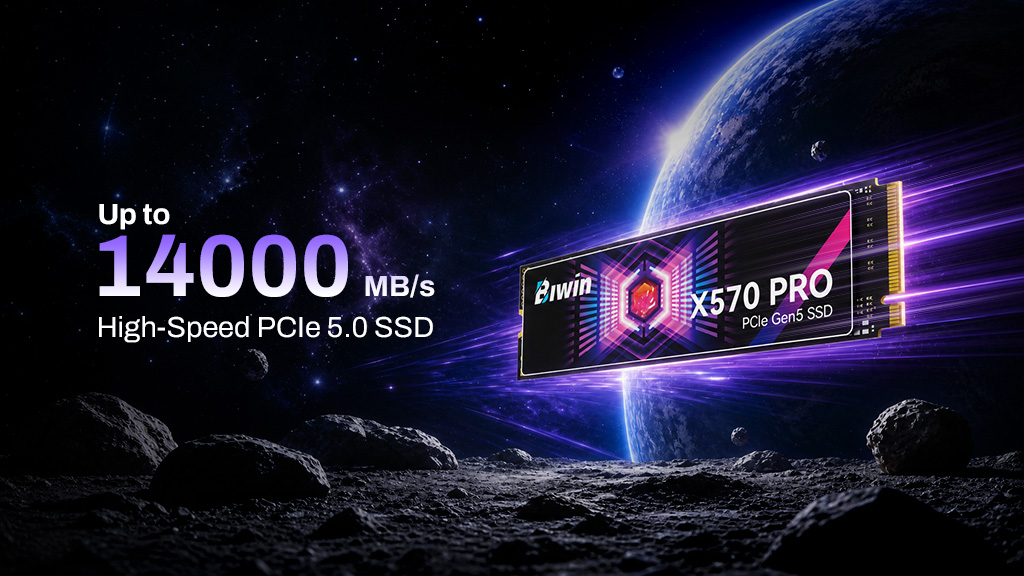
Thanks to its PCIe 5.0 interface and advanced controller, the X570 Pro can deliver read speeds of up to 14,000 MB/s, giving AI workloads extremely fast access to the data they need. That kind of throughput helps keep expensive GPU resources working hard instead of waiting on storage to deliver.
Endurance and reliability for long training runs
To protect all of that valuable data, endurance is just as important as raw performance. The X570 Pro offers TBW ratings up to 6,000, ensuring that even with frequent model updates, checkpoint saves, and retraining cycles, the drive is built to withstand heavy, sustained write workloads over time. These are drives that can be relied on for training workload after training workload, and year after year of faithful operation.
That endurance is supported by the use of high-quality NAND flash. While QLC NAND-based SSDs can appear attractive on paper, with high capacities and lower cost, their write endurance typically cannot match drives built on higher-end NAND. For critical AI training data and long-running jobs, it pays to choose SSDs designed for reliability and consistency over the long term. A drive failure in the middle of training can compromise results or force costly restarts of lengthy, expensive runs.
To help that endurance last, Biwin industrial SSDs are equipped with advanced Dynamic Wear Leveling to distribute wear evenly across the NAND cells during write cycles. Robust TRIM and garbage collection mechanisms further help the drive maintain its performance throughout its lifespan.
Beyond training: SSDs for AI inference at scale
Fast, durable storage is at its most important during training, but it has uses at the inference level of AI operation, too. Serving generative AI to millions of users means constantly loading model weights, prompts, context, and results, which is exactly the kind of workloads NVMe SSDs are designed for. Low-latency NVMe SSDs help minimise response times and keep inference servers running smoothly, even under heavy loads and high-demand. As models grow and context windows expand, the ability to scale out with high-capacity, high-endurance SSDs becomes a key part of total cost of ownership. By choosing industrial-grade drives from the start, AI builders can reduce unplanned downtime, simplify fleet management, and support future generations of larger, more capable models on the same storage infrastructure.